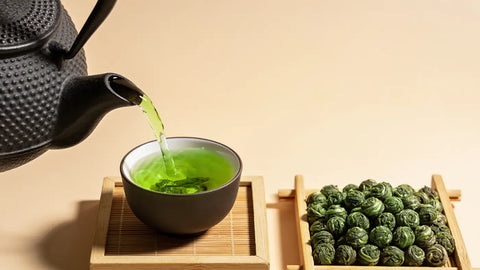
Mecha tea is a Japanese green tea made from the young buds and tips separated during the production of sencha and gyokuro.
The name itself explains everything: 'me' (芽) means 'bud' in Japanese, and 'cha' means tea. What you are brewing is a concentrated collection of the youngest, most nutrient-dense parts of the tea plant.
Because these buds are separated out during the processing of higher-grade teas, mecha tea sits in an interesting position: same raw material, fraction of the price.
It brews fast, re-infuses multiple times, and delivers a bold, astringent cup that has made mecha tea a staple after-dinner choice in sushi restaurants across Japan.
If you want to explore what Japan's traditional tea culture is actually about, this article covers everything worth knowing.
Mecha Tea: A Japanese Green Tea Made from Young Leaf Buds

Mecha tea is produced from the smallest buds and tips that are sorted out during the manufacture of sencha, kabusecha, or gyokuro, similar in concept to aracha, the unrefined raw tea that also emerges before final sorting and grading. When tea leaves are rolled and shaped, the soft young buds at the tip naturally break away from the longer needle-shaped leaves. Those buds are collected, dried, and sold as mecha.
The buds are noticeably small and round rather than the long, flat needle shape you would associate with most Japanese green teas, though tamaryokucha, another curled-leaf green tea, also breaks from the standard needle form for entirely different reasons. That form comes from its higher water content at harvest, which causes it to roll into compact little balls during processing.
Most mecha tea on the market comes from the first or second harvest of the year, when the plant's nutrients are at their seasonal peak. This makes it meaningfully different from teas like bancha, which are harvested from older, more mature leaves in later flushes.
Where Mecha Tea Fits in the Japanese Tea Landscape
Japanese tea has a structured hierarchy, and mecha sits in an unusual position within it. It shares the same source leaves as some of the most expensive teas in Japan, yet it is classified and priced as a byproduct of their production.
Its Connection to Sencha and Gyokuro
When a batch of sencha is processed, the finished leaves are sorted by size, shape, and grade, a step that sets sencha apart from less refined green teas and, as covered in the tamaryokucha vs sencha comparison, highlights how processing method defines each tea's identity. The bud tips that do not conform to the standard needle shape get separated out. Those are mecha. The same happens with gyokuro, producing what specialists sometimes label gyokuro-mecha, a rarer version that carries the characteristic seaweed-like aroma of shade-grown tea.
This means that mecha green tea, at its best, comes from the same fields, the same cultivars, and the same early-season harvest as Japan's most prized teas. The difference is entirely in the physical form of the leaf, not in the quality of the plant material used to produce it. The gap between gyokuro-mecha and standard mecha starts in the field, not the cup. 👉 Gyokuro vs Sencha: Health Benefits, Caffeine, Taste, & More
How Mecha Compares to Konacha

Mecha tea is often confused with konacha, the small-particle tea served in most sushi restaurants. Both are byproducts of Japanese tea processing, and both brew dark and fast. The difference is that mecha retains visible, rounded bud tips, while konacha is finer and more dust-like.
For the drinker, mecha tends to produce a slightly more complex aroma and a fuller body, whereas konacha brews sharper and thinner. Some tea shops in Japan serve a blend of both for the restaurant-style dark green cup most people recognise.
What Makes Mecha Different from Other Japanese Green Teas
The Importance of Leaf Buds
Young tea buds contain a higher concentration of compounds than any other part of the plant. Catechins, the polyphenols responsible for astringency and antioxidant activity, are more abundant in the tips. Caffeine is also concentrated in the buds, which explains why mecha brews with noticeably more bite than a standard sencha made from the same plant.
For gyokuro-derived mecha, the shading process adds another dimension. Shade-grown plants produce elevated L-theanine, the amino acid responsible for umami depth and calm focus. When the buds of these plants end up in mecha green tea, the theanine richness carries through into the cup in a way that standard sencha does not replicate. The depth that shade-growing adds to tea is worth understanding in full before brewing gyokuro-mecha. 👉 What Does Gyokuro Taste Like? The Umami Truth
Why Mecha Develops Its Distinctive Character
The compact, rolled shape of mecha buds means they release their compounds quickly. A 30-to-40-second steep in water around 75 to 80 degrees Celsius is typically enough to produce a full-bodied first infusion, a precision approach to temperature and timing that applies equally to other delicate Japanese greens, as explored in the guide on how to brew tamaryokucha. Steeping longer does not improve the cup; it tips the balance firmly toward bitterness.
This rapid extraction also means mecha tea responds well to multiple infusions. Each steep draws out a different profile: the first is bold and direct, while subsequent infusions become progressively lighter and more nuanced. Nio Teas carries a selection of Japanese loose leaf teas where you can explore how different green teas compare in terms of re-steepability and depth.
Flavor Profile and Caffeine Characteristics of Mecha Green Tea

Mecha green tea has a sharp, assertive flavor with pronounced astringency and a bitter green finish. It is not a delicate tea. The aroma is grassy and slightly marine, more forward than sencha, and it brews to a clear, soft yellow-green liquor when prepared at the correct temperature.
The caffeine level is higher than that of most other Japanese green teas, including standard sencha, and given that sencha itself is already valued for its health-supporting catechins and antioxidants, mecha's bud-concentrated composition makes it an even more potent source of those same compounds. This makes mecha tea an effective morning brew or a useful palate cleanser after a rich meal, which is exactly how sushi restaurants in Japan have been using it for decades.
For those sensitive to caffeine, a shorter steep time or a slightly lower water temperature can reduce extraction without sacrificing the core flavour. The astringency that defines mecha green tea comes primarily from catechins rather than caffeine, so adjusting temperature affects bitterness more than it affects that characteristic sharp bite.
How Mecha Is Appreciated by Japanese Tea Enthusiasts
In Japan, mecha does not carry the prestige of gyokuro or single-cultivar sencha, but it has a loyal following among those who value intensity over elegance. It is the kind of tea that serious drinkers reach for when they want something that feels alive in the cup.
Japanese tea culture places value on the relationship between a tea's origin and its processing. Mecha's appeal lies in the fact that its raw material is premium, even if its market position is not. A well-sourced mecha from a first-harvest Uji or Nishio crop can be genuinely exceptional. You can read more about how Japanese growing regions shape tea character in related articles on the Nio Teas Japanese tea blog.
Mecha is also one of the few traditional Japanese teas that genuinely benefits from a kyusu with a fine mesh filter. The small, compact buds can pass through coarser strainers, so a proper fine-mesh kyusu makes a practical difference to how clean the final cup ends up.
Why Mecha Tea Deserves More Attention
Most people encounter mecha tea for the first time at a Japanese restaurant, after tasting the dark, bold green tea and asking what it was. The answer is usually a blend of mecha and konacha, the combination that gives that restaurant-style brew its distinctive depth and dark colour.
Outside Japan, mecha green tea remains genuinely rare. It is produced in small quantities because it is a byproduct of higher-grade teas rather than a dedicated harvest. That scarcity, combined with its premium raw material, makes it one of the more interesting undervalued teas in the Japanese canon.
If you have been working through the range of Japanese loose leaf teas and want something bold that still connects to the top end of the quality spectrum, mecha is worth seeking out. It rewards a little attention to brewing but offers a cup with real weight and character at a price that reflects its byproduct status rather than its ingredient quality.